
In the world of cloud computing and distributed systems, the ability to handle increasing workloads is crucial for success. This scalability is achieved through two primary methods: vertical scaling and horizontal scaling. While both aim to improve performance, they differ significantly in approach, cost, and complexity. Understanding these differences is essential for making informed decisions about your infrastructure — especially if you are building or scaling a SaaS product.
Introduction to Scaling
Scaling refers to the capability of a system to handle growing amounts of work or its potential to be enlarged to accommodate that growth. As user demand increases, applications and services must adapt to maintain performance and availability. Without proper scaling strategies, systems can experience slowdowns, crashes, and poor user experiences.
The two fundamental approaches to scaling are vertical scaling (scaling up) and horizontal scaling (scaling out). Each has its own set of advantages and disadvantages, making the choice dependent on factors like application type, budget, and performance requirements.
Vertical Scaling (Scaling Up)
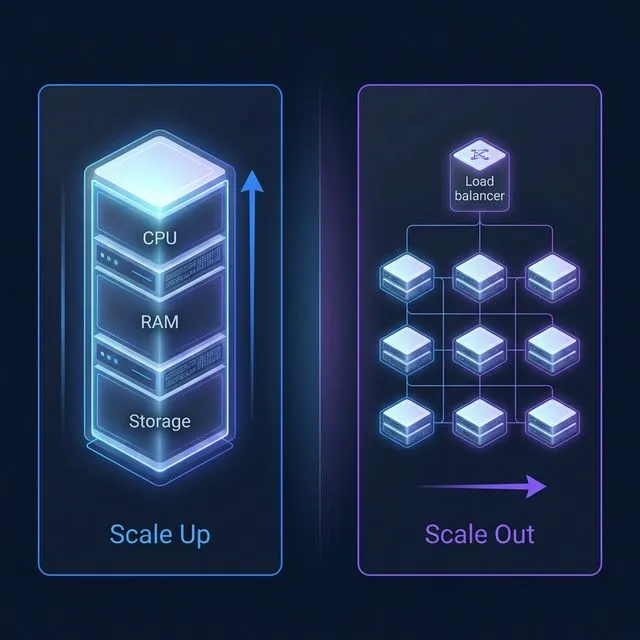
Vertical scaling involves increasing the resources of a single server or node. This means adding more CPU power, RAM, storage, or network capacity to an existing machine. Think of it like upgrading a single computer to handle more demanding tasks.
How It Works
When you vertically scale, you are essentially making your server more powerful. For example, you might upgrade a server from 8GB of RAM to 32GB, or replace a dual-core processor with a quad-core or octa-core processor. This is often achieved by adding physical components or upgrading to a higher-tier instance in a cloud environment like AWS EC2.
Advantages
- Simplicity: Vertical scaling is relatively straightforward to implement. It does not require complex architectural changes or load balancing configurations.
- Easier Management: With fewer machines to manage, administration and monitoring become simpler.
- No Code Changes: Most applications can benefit from vertical scaling without requiring significant code modifications.
Disadvantages
- Downtime Required: Upgrading a server typically requires taking it offline, which can cause service interruptions.
- Hardware Limitations: There is a physical limit to how much you can scale a single machine. Eventually, you will reach the maximum capacity of available hardware.
- Single Point of Failure: If the single server fails, the entire application goes down. This creates a critical point of failure.
- Cost: High-end servers with extensive resources can be very expensive, and costs increase exponentially with each upgrade.
When to Use It
Vertical scaling is best suited for:
- Small to medium-sized applications
- Applications with predictable workloads
- Systems where downtime is acceptable
- Legacy applications that are difficult to distribute
Horizontal Scaling (Scaling Out)
Horizontal scaling involves adding more servers or nodes to a system to distribute the workload. Instead of making one server more powerful, you add more servers to work together. This is the foundation of modern cloud-native architectures and microservices.
How It Works
Horizontal scaling requires a way to distribute incoming requests across multiple servers. This is typically achieved using load balancers, which act as traffic directors. Each server runs an identical copy of the application, and the load balancer sends requests to them based on availability and load. Cloud platforms like AWS Auto Scaling and Kubernetes Horizontal Pod Autoscaler automate this process, adding or removing server instances based on real-time demand.
Advantages
- High Availability: If one server fails, the load balancer can redirect traffic to the remaining servers, ensuring continuous operation.
- No Downtime: New servers can be added without interrupting service, allowing for seamless scaling.
- Cost-Effective: It is often cheaper to use multiple commodity servers than one high-end mainframe.
- Near-Infinite Scalability: Theoretically, you can continue adding servers indefinitely to handle increasing loads.
Disadvantages
- Increased Complexity: Horizontal scaling requires more complex architecture, including load balancing, service discovery, and distributed state management.
- Application Modifications: Applications need to be designed to support horizontal scaling, often requiring changes to handle distributed data and sessions.
- More to Manage: Managing multiple servers requires more sophisticated monitoring and automation tools.
When to Use It
Horizontal scaling is ideal for:
- Web applications with variable traffic
- Microservices architectures
- Applications requiring high availability
- Big data processing and analytics
Key Differences Summarized
To better understand the distinction between the two approaches, here is a summary of the key differences:
| Feature | Vertical Scaling | Horizontal Scaling |
|---|---|---|
| Method | Increase resources on a single server | Add more servers to the system |
| Downtime | Usually required | Not required |
| Scalability Limit | Limited by hardware | Near-infinite |
| Failure Impact | Single point of failure | Fault-tolerant |
| Cost | Can be expensive at higher tiers | Cost-effective |
| Complexity | Low | High |
Hybrid Scaling: The Best of Both Worlds
In many real-world scenarios, a hybrid approach that combines both vertical and horizontal scaling offers the optimal solution. This strategy allows organizations to leverage the simplicity of vertical scaling for baseline capacity while using horizontal scaling to handle peak loads and ensure high availability.
For example, a company might maintain a core set of powerful servers (vertical scaling) for the primary database, and then automatically add more application servers (horizontal scaling) when traffic spikes occur. A caching layer using Redis or a distributed database like CockroachDB can bridge the data consistency gap that horizontal scaling introduces. This approach provides flexibility, cost-effectiveness, and resilience.
Choosing the Right Approach for Your Business
The decision between vertical and horizontal scaling depends on several factors specific to your application and business needs:
- Current Workload: If your application has predictable traffic patterns and moderate resource needs, vertical scaling may be sufficient.
- Growth Projections: For applications expected to experience significant growth or unpredictable traffic spikes, horizontal scaling is essential.
- Budget Constraints: Horizontal scaling is generally more cost-effective for large-scale applications, while vertical scaling can be more economical for smaller projects.
- Technical Expertise: Implementing and managing horizontal scaling requires more technical expertise and specialized tools.
- Availability Requirements: If your application must be available 24/7, horizontal scaling with proper redundancy is the clear choice.
Real-World Examples
Let's consider a few examples to illustrate how these scaling strategies are applied in practice:
- E-commerce Platform: During holiday seasons, e-commerce sites experience massive traffic spikes. Horizontal scaling allows them to add more servers to handle the load, while vertical scaling might be used to upgrade database servers for better performance.
- SaaS Application: A Software as a Service (SaaS) company might use vertical scaling for their core application servers but implement horizontal scaling for their microservices architecture to ensure high availability and fault tolerance.
- Mobile App Backend: A popular mobile app needs to handle millions of concurrent users. This requires a horizontally scaled architecture with load balancing and distributed databases to ensure fast response times and reliability.
Conclusion
Both vertical and horizontal scaling are critical concepts in modern infrastructure management. Vertical scaling offers simplicity and ease of management but is limited by hardware constraints and creates a single point of failure. Horizontal scaling provides near-infinite scalability, high availability, and cost-effectiveness but introduces architectural complexity.
The best approach often involves a hybrid strategy that combines the benefits of both methods. By understanding your application's specific needs and growth patterns, you can design an infrastructure that is scalable, reliable, and cost-effective. If you are planning an architecture review or need help designing a scalable system, see examples of products we have scaled or browse our full engineering and product archive.
Reader Thoughts
0 comments — join the conversation
Be the First
No thoughts shared yet. Start the conversation with your unique insight.